In May 2026, r/sportsbetting reopened with one of the most
consequential rules in the community’s history: No touts. No
spam. No selling picks.
The new mods didn’t just ban affiliate links and “tail me for
$100/month” posts. They re-anchored what the community values. The new
house rules explicitly prioritize “slips, deep-dives, and genuine
discussion” over pick-of-the-day promotion. Translation:
process now outranks plays.
This shift didn’t come from nowhere. It reflects what sharp bettors
have been saying for a decade — quietly on private Discords, loudly on
X, and now formally in the largest English-speaking sports betting forum
on the internet. The pick is the output. The process is the asset.
If you’re trying to actually beat the books in 2026 — not break even,
not “almost profitable,” but compound a real edge — you need a
methodology, not a guru. Here’s the complete framework.
Why “Just Tail My Picks”
Stopped Working
For most of the last decade, the path to “winning at sports betting”
looked like this:
- Find a handicapper with a good run
- Pay $50-$200/month
- Tail their plays
- Hope the run continues
The math never worked, but the marketing was excellent. Bettors who
came up through Twitter screenshots, Discord call-outs, and Instagram
bet-slip flexes genuinely believed that the right capper was the only
missing piece.
Three things broke that model in 2026:
1. The trust crisis went mainstream. Reddit’s
relaunch isn’t an isolated event. The BBB coined the term
“scamicappers” this year. The NBA gambling indictments (Damon
Jones pled guilty in April; Terry Rozier’s superseding indictment
dropped in May) put “insider information” claims on every casual
bettor’s red-flag list. A practitioner-bettor on X put it bluntly in
May: “Many handicappers of my skill level sell picks, which is
always a scam.”
2. Tools got radically better. What used to require
a $400/month boutique service is now baked into +EV software like AVO and Outlier. The
information asymmetry that handicappers used to monetize has
collapsed.
3. The math got publicized. Tracking platforms like
Pikkit and SlipSync let bettors compare verified records side-by-side.
The illusion that “this capper hits 65%” rarely survives third-party
verification.
Sharp bettors didn’t suddenly become smarter. The infrastructure that
lets you build your own edge — and verify someone else’s — finally
caught up. If you’re still paying for picks in 2026, you’re paying for
narrative, not numbers.
The Six-Pillar Sharp
Bettor Methodology
A sustainable betting process has six components. None of them is
optional. You can’t replace any of them with a handicapper, an AI, or a
Twitter follow.
Pillar 1: Bankroll & Unit
Sizing
Your bankroll is the only number that matters long-term. Everything
else — win rate, ROI, CLV — is downstream of how much you risk per bet
and how disciplined you are when variance hits.
The standard sharp framework:
- 1 unit = 1% of bankroll (some sharps use 2%, almost
never higher) - Flat betting beats progression over any meaningful
sample - Recalibrate your unit size monthly, not after every
win/loss
If you’re betting “to the moon” parlays on weekends and 5-unit
moneylines when you “feel one,” you don’t have a methodology. You have a
hobby that occasionally pays. Read our bankroll
management guide for the full unit-sizing breakdown.
Pillar 2: Line Shopping
This is the single highest-ROI action available to retail bettors and
nobody talks about it because there’s nothing to sell. The math:
A bettor who hits -110 lines breaks even at 52.4%. A bettor who shops
three books and consistently captures +5 cents of value (so -105 instead
of -110) breaks even at 51.2%. Over a year of normal volume, that’s the
difference between losing money and being a profitable bettor — entirely
from the action of opening two extra tabs.
Tools like AVO, OddsJam, and Outlier exist primarily to make line
shopping fast enough to do on every bet. We covered the full mechanics
in our line
shopping guide.
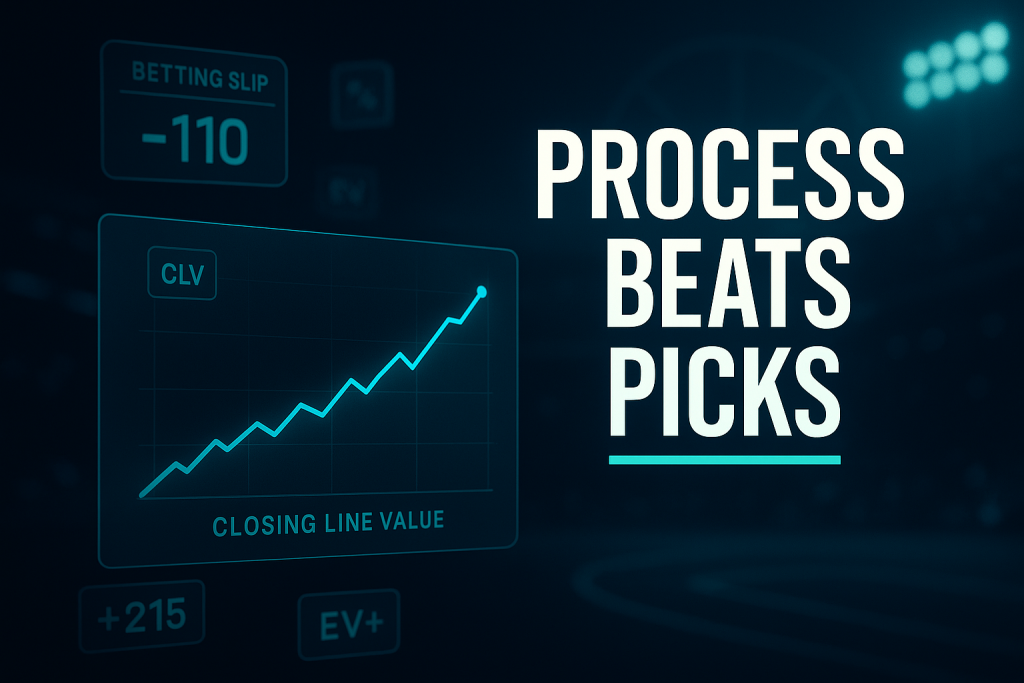
Pillar 3: Closing Line Value
(CLV)
CLV is how sportsbooks decide who to limit, and it’s how you decide
whether your process actually works.
The concept: if you bet a team at -3 (-110) and the line closes at
-4, you “beat the close” by 1 point. If you do that consistently —
across hundreds of bets — you are, by definition, betting better than
the closing market. The market closes at the fairest possible price
(after the sharpest action). Beating it means you’re a price-maker, not
a price-taker.
Practical mechanics:
- Log every bet with its line + the closing line
- Track average CLV per bet (target: +0.5% to +1%)
- Use a free tool like Unabated’s CLV calculator if you don’t want to
track manually - CLV is leading, win rate is lagging. If your CLV is
positive and your win rate is negative, your process is correct and
you’re in a variance pocket. If your CLV is negative but you’re winning,
you got lucky — stop confusing it for skill.
Our CLV
deep dive walks through how to calculate it, what targets to hit,
and what to do when the number tells you to stop.
Pillar 4: Bet
Tracking & Record Verification
If you can’t see your record, you don’t have a record. You have a
vibe.
Three tools dominate the 2026 tracker market, each with a different
value prop:
- Pikkit — Best for casual-to-intermediate bettors
who want auto-sync from major sportsbooks - SlipSync — Best for sharps who bet across many
books (screenshot upload for books that don’t auto-integrate) - Betstamp — Best for bettors who want odds-screen +
click-to-track in one tool
We compared all three in detail in our bet
tracker showdown — pick the one that matches how you actually bet,
not the one with the prettiest UI.
Pillar 5: Process for Bet
Selection
This is the layer most bettors confuse with “the system.” It’s not
the whole system — it’s the input that determines whether the rest of
the methodology even has a chance.
You don’t need a unique handicapping edge to win. Most profitable
retail bettors are running one of three repeatable processes:
A) +EV Betting. Use a tool (AVO, OddsJam, Outlier)
to identify bets where the offered odds imply a probability lower than
the true probability. Bet whenever the EV crosses your threshold. Win
rate is usually 50-55%; ROI is 2-5%.
B) Arbitrage. Capture mispriced lines across two
books for a guaranteed return. Lower upside, near-zero variance, faster
account-limiting. Our arbitrage
guide covers the trade-offs.
C) Specialist Handicapping. Pick one niche (NBA
player props, MLB run lines, college football conference matchups) and
develop genuine expertise. Slowest to scale but lowest dependency on
tools, books, and middlemen.
The mistake most bettors make: trying to combine all three without
mastering one. Pick a lane. Execute.
Pillar 6: Emotional
Process (Yes, Really)
Variance is brutal. Even profitable processes lose 30-40% of the time
over short windows. The bettor who walks away after Week 1 of a 7-9
stretch never finds out their process was correct.
The emotional process has three rules:
- Pre-commit to your unit size in writing. When
you’re up 20%, you’ll want to press. When you’re down 20%, you’ll want
to chase. Both kill the process. - Time-box your review. Don’t recalibrate your
strategy after a single bad day. Review weekly at minimum, monthly is
better. - Have a stop-loss. If you draw down 25% of your
bankroll, you stop betting until you’ve reviewed every single bet.
Either your process broke (rare) or you broke discipline (almost
always).
What This Methodology
Replaces
The framework above replaces every paid handicapper service you’d
otherwise consider. Not because handicappers are universally bad — there
are legitimate ones, and we’ve reviewed many of them on our Best
Handicappers on Whop pillar. It’s because the handicapper is solving
for picks, and what you actually need is
process.
A legitimate handicapper at $50-$200/month gives you their bet
selection. The methodology above gives you:
- Bet selection (Pillar 5)
- Line execution (Pillar 2)
- Verification (Pillars 3 + 4)
- Risk management (Pillars 1 + 6)
The handicapper solves 20% of the problem and charges you for 100% of
it. The methodology solves all of it and costs you the price of two tool
subscriptions.
If you’re still going to subscribe to a service, look for the
process-first voice — the handicapper who tells you not
to blindly tail, who teaches methodology in the free Discord, who shares
CLV data instead of just W/L. They exist (LukaOhtani is one of the
loudest in 2026), and they’re the only category where the math actually
justifies the subscription.
The Tools That Hold
the Framework Together
You don’t need to spend $1,000/month to run this methodology. A
complete sharp stack in 2026 looks like this:
| Tool | Purpose | Approx Cost |
|---|---|---|
| AVO | +EV scanner / line shopping | $79/mo |
| Outlier | Player props / direct bet placement | $19.99-$99/mo |
| Pikkit or SlipSync | Bet tracking + CLV | $0-15/mo |
| Unabated CLV calculator | Free closing line tracking | Free |
That’s $100-$200/month total for a complete sharp infrastructure. The
same money you’d pay one VIP handicapper for output gets you the entire
process — input, verification, and execution.
The Sharp Bettor’s Weekly
Routine
What does this look like in practice? Here’s the rhythm of a
process-first bettor:
Monday – Review last week’s bets in Pikkit/SlipSync
– Calculate average CLV – Flag any process violations (overbets,
untracked plays, off-strategy picks)
Tuesday-Friday – Run +EV scans (AVO/Outlier) before
market open – Place bets within the first 2-4 hours of line release
(sharper prices, looser limits) – Log every bet with line + book
Saturday-Sunday – Heavy bet day — line shop every
bet across 3+ books – Track CLV in real time as lines close – Pre-commit
unit size before placing any bet
Sunday Night – Bankroll check – Decision: stay on
process, recalibrate, or stop-loss
Nothing in that routine requires “feeling the line” or “trusting the
capper.” It’s repeatable, verifiable, and — most importantly — scalable.
The bettor who runs this routine for 12 months and posts to
r/sportsbetting will get upvoted, not banned.
What the
New Reddit Rules Actually Mean for Bettors
When r/sportsbetting banned touts, it wasn’t anti-business. It was
pro-bettor. The community decided that the value isn’t in the picks
people share — it’s in the methodologies, the bet-slip post-mortems, and
the deep-dives. That’s the same conclusion sharp bettors reached
privately a decade ago.
If you’re new to sports betting and you’re trying to find someone to
“just tell you what to bet,” you’re going to find that the resources you
trusted — Reddit, sharp Twitter, the better Discords — have all migrated
the same direction. They’ll teach you the framework. They won’t sell you
the plays.
That’s the opportunity. Build the framework. Run the process. Verify
the CLV. The picks come out at the end of the methodology, not the
beginning of it.
Related Articles
- Stanley Cup Final 2026 Game 2 Picks: Vegas vs. Carolina Sharp Bets & Eichel Props
- How Whop Handicappers Can Defend Track Records Against Scam Accusations in 2026: The Survivorship Bias Counter-Narrative Playbook
- Closing
Line Value Explained: The Most Important Metric in Sports
Betting - Line
Shopping Guide 2026: How to Find the Best Odds and Save
Thousands - Bankroll
Management for Sports Betting 2026: The Complete Guide to Unit
Sizing - Pikkit
vs SlipSync vs Betstamp: The Best Bet Tracker for Sharp Bettors in
2026 - Best
Sports Betting Tools 2026: Complete Guide to +EV Software - Best
Sports Handicappers on Whop in 2026: Complete Guide &
Reviews