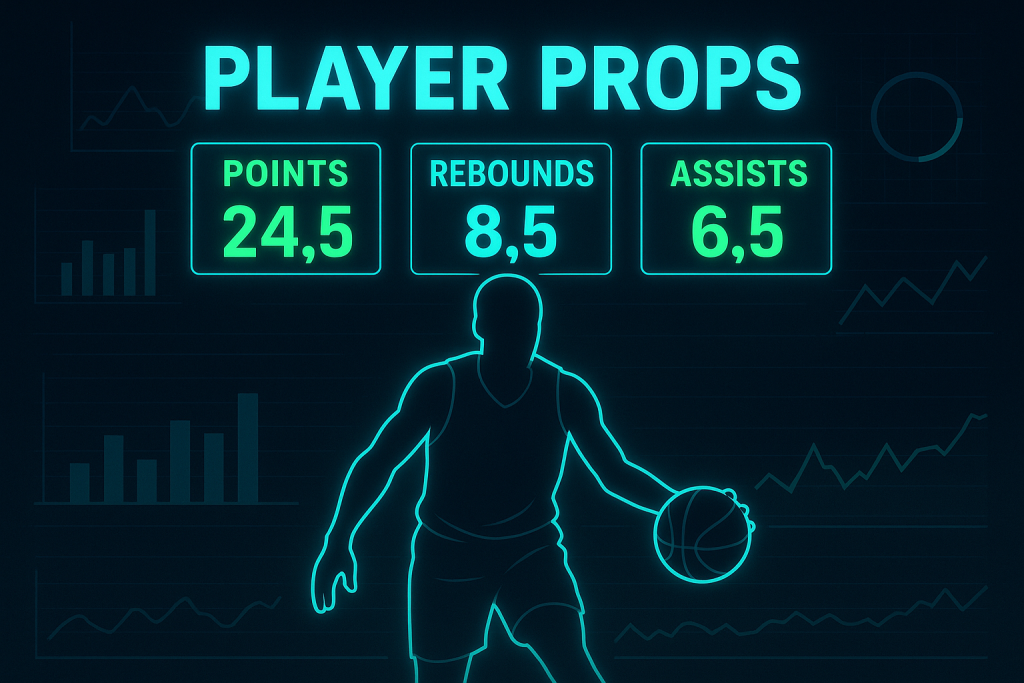
What Are Player Props?
Player props are bets on individual player performance — not on which team wins. Instead of betting on the Lakers to cover the spread, you’re betting on LeBron James to score over 25.5 points.
It sounds simple, but player props have become one of the most popular — and potentially profitable — ways to bet on sports. Here’s why bettors love them:
- More control: You’re betting on one player, not an entire team
- Softer lines: Sportsbooks spend more resources setting spreads and totals
- More opportunities: Dozens of prop markets per game
- Better for specialists: Deep knowledge of specific players pays off
This guide covers everything you need to know about player props in 2026: how they work, which sports offer the best opportunities, and strategies that actually work.
How Player Props Work
Every player prop has three components:
1. The Player — Who you’re betting on (e.g., Stephen Curry)
2. The Stat — What metric you’re predicting (e.g., three-pointers made)
3. The Line — The threshold you’re betting over or under (e.g., 4.5 threes)
Reading Prop Lines
Here’s a typical prop bet:
Patrick Mahomes — Passing Yards
- Over 285.5 (-115)
- Under 285.5 (-105)
This means:
- If Mahomes throws for 286+ yards, the over wins
- If Mahomes throws for 285 or fewer yards, the under wins
- The (-115) means you risk $115 to win $100 on the over
- The (-105) means you risk $105 to win $100 on the under
The difference in odds tells you the sportsbook thinks the under is slightly more likely — that’s called “juice” or “vig.”
Types of Player Props
Different sports offer different prop markets. Here’s what’s available:
NBA Player Props
| Prop Type | Examples | Best For |
|---|---|---|
| Points | Jayson Tatum O/U 28.5 | Scoring analysis |
| Rebounds | Anthony Davis O/U 11.5 | Big man specialists |
| Assists | Luka Doncic O/U 8.5 | Playmaker analysis |
| 3-Pointers Made | Steph Curry O/U 4.5 | Shooter trends |
| Combos (PRA) | Giannis O/U 45.5 PRA | High-volume plays |
| Steals/Blocks | OG Anunoby O/U 1.5 steals | Defensive stats |
NFL Player Props
| Prop Type | Examples | Best For |
|---|---|---|
| Passing Yards | Josh Allen O/U 275.5 | QB analysis |
| Passing TDs | Lamar Jackson O/U 2.5 | Red zone analysis |
| Rushing Yards | Derrick Henry O/U 85.5 | Workload trends |
| Receiving Yards | Ja’Marr Chase O/U 78.5 | Target share |
| Receptions | Travis Kelce O/U 5.5 | Volume analysis |
| Anytime TD | Saquon Barkley +120 | Goal-line work |
MLB Player Props
| Prop Type | Examples | Best For |
|---|---|---|
| Strikeouts | Spencer Strider O/U 8.5 | Pitcher analysis |
| Hits | Ronald Acuña Jr. O/U 1.5 | Batter matchups |
| Total Bases | Shohei Ohtani O/U 1.5 | Power hitting |
| Hits+Runs+RBIs | Mookie Betts O/U 2.5 | Multi-stat plays |
| Outs Recorded | Pitcher O/U 17.5 | Innings pitched |
NHL Player Props
Hockey props are less liquid but offer value:
- Points: Goals + Assists combined
- Shots on Goal: High-volume shooters
- Saves: Goaltender props
- Anytime Goalscorer: Similar to anytime TD
Why Player Props Can Be +EV
Player props often have softer lines than spreads and totals. Here’s why:
1. Sportsbooks Have Limited Resources
Major sportsbooks employ sharp analysts to set point spreads — millions of dollars are wagered on these markets. But a typical NBA game has 50+ player prop markets. Books simply can’t devote the same attention to each one.
2. Public Betting Creates Biases
The public loves betting overs on star players. If Patrick Mahomes is playing, casual bettors hammer his passing yards over. This creates artificial inflation on star player overs, making unders potentially valuable.
3. Information Asymmetry
A bettor who closely follows a specific team or player can gain an edge through:
- Injury knowledge (minutes restrictions, nagging injuries)
- Lineup information (starter returns, rotation changes)
- Matchup expertise (defensive schemes, pace of play)
- Situational factors (back-to-backs, travel)
For more on finding value in betting markets, check out our guide to the best betting tools in 2026.
Player Props Strategy: 6 Key Principles
1. Understand Minutes/Playing Time
This is the single most important factor for props, especially in basketball. A player projected for 35 minutes has fundamentally different props than one playing 28 minutes.
Check for:
- Load management days
- Injury returns (minutes restrictions)
- Blowout risk (starters sit in 4th quarter)
- Back-to-back games (fatigue, rest)
2. Factor in Game Context
The game total and spread tell you a lot about what to expect:
High totals (NBA 230+, NFL 50+):
- More possessions = more stat opportunities
- Star players stay in longer
- Both teams pushing pace
Low totals (NBA under 215, NFL under 40):
- Slower pace
- More defensive focus
- Unders on volume stats can hit
Large spreads:
- Favorite’s stars might sit in garbage time
- Underdog’s players might have inflated numbers in catch-up mode
3. Track Matchups
Individual matchups matter more for props than any other bet type:
Basketball:
- Is the opposing team elite at defending the 3-point line?
- Do they struggle to contain pick-and-roll ball handlers?
- Is there a size mismatch in the post?
Football:
- Is the defense vulnerable to the run or pass?
- Does the cornerback matchup favor the receiver?
- Is the offensive line healthy against a pass-rush team?
4. Use Projections, Not Just Averages
A player averaging 25 points per game doesn’t mean their line should be 24.5. Projections account for:
- Opponent strength
- Home/away splits
- Recent performance trends
- Pace and efficiency factors
Tools like Outlier provide data-driven projections specifically designed for player props. Their models factor in matchups, rest, and situational variables that simple averages miss.
5. Shop Lines Aggressively
Prop lines vary significantly across sportsbooks. A player might be:
- 21.5 points at DraftKings
- 22.5 points at FanDuel
- 21.5 points at Caesars (but with better juice)
That single point can be the difference between a win and a loss. Always compare lines across multiple books before placing prop bets.
For comprehensive odds comparison, tools like OddsJam and AVO let you instantly compare prop lines across all major sportsbooks.
6. Manage Variance
Player props have high variance. A starter might get injured in the first quarter, or a game could become a blowout that empties benches early.
Best practices:
- Bet 1-2% of bankroll per prop (smaller than spread bets)
- Avoid correlated props that all fail together
- Track results over 500+ bets before judging your edge
For more on managing your betting bankroll, see our complete bankroll management guide.
Tools for Player Props Bettors
The best prop bettors use data, not gut feelings. Here are the top tools:
Projection Tools
The best tool specifically designed for player props. Their projections factor in matchups, pace, and situational variables. Especially strong for NBA and NFL props. Read our full Outlier review.
Odds Comparison
Compares prop lines across all sportsbooks instantly. Shows you when a line is off at one book compared to others. Essential for line shopping. Full OddsJam review.
More affordable alternative that’s gained popularity among prop bettors. Strong odds comparison and +EV identification.
Handicapper Services
Some bettors prefer following expert picks rather than doing their own analysis. For player props specifically:
Dedicated player props service with strong track record. Focus exclusively on props across all major sports. Read our PropFellas review.
For more handicapper options, see our complete guide to sports handicappers on Whop.
Common Player Props Mistakes
Mistake 1: Only Betting Overs
The public loves overs. “Of course LeBron is going over 25 points!” This bias inflates over lines. Don’t be afraid to take unders when the math supports it.
Mistake 2: Ignoring the Game Script
If a team is a 15-point favorite, their star players might only play 30 minutes instead of 38. Factor in blowout risk, especially for overs.
Mistake 3: Chasing Recent Performance
A player had a 40-point game last night, so you hammer their points over today. But that game was against the league’s worst defense. Today they face an elite defensive team. Context matters.
Mistake 4: Parlaying Correlated Props
Betting the same player’s points over AND assists over doesn’t diversify your risk — both fail if the player has a bad game or leaves early.
Mistake 5: Not Tracking Results
You need to know if your prop betting is actually profitable. Track every bet with the stat, line, odds, and result. Analyze what’s working after 200+ bets.
Building a Player Props System
Successful prop bettors develop repeatable processes:
Daily Routine:
- Check for injury news and lineup changes
- Review projections from your preferred tool
- Compare projections to available lines
- Identify lines with significant edge
- Line shop for the best price
- Place bets at 1-2% of bankroll each
Weekly Review:
- Track closing line value (did the line move your way?)
- Analyze which prop types perform best for you
- Identify leaks in your process
- Adjust based on results
The Bottom Line
Player props offer some of the best opportunities in sports betting — if you approach them systematically. The key principles:
- Playing time is everything — always verify expected minutes
- Game context shapes outcomes — totals and spreads matter
- Use projections, not just averages — tools like Outlier exist for a reason
- Line shop religiously — a half-point matters more in props
- Manage variance — smaller bets, larger sample sizes
Whether you build your own models or follow expert picks, player props reward bettors who do their homework. The sportsbooks can’t perfectly price 50 markets per game. That’s your edge.
Related Articles
- WNBA Player Props in 2026: How Sharp Bettors Are Crushing the Softest Market in Pro Sports
- PrizePicks vs Underdog Pick’em vs DraftKings Pick6: Best DFS Pick’em App for Sharp Players in 2026
- Best Sports Betting Tools 2026: Complete Guide to +EV Software
- PropFellas Review 2026: Is This Player Props Service Worth It?
- Outlier Betting Software Review 2026
- How Long Does +EV Betting Take to Be Profitable?
- Best Sports Handicappers on Whop 2026: Complete Guide